I’ve written before about the three levels of lessons learning: lessons for me (personally, whether privately or declared), lessons for us (the team, together), lessons for all of us (the company and wider world). All three levels can occur in a lessons learned process, although most commonly it’s only the lessons for me and lessons for us levels that do – if that – unless there’s a process of escalating, reviewing and actioning matters at a higher, organisational level. That’s the real organisational learning, and, as I always say, it’s not a lesson learned if it’s only intellectually noted: to be learned it has to be acted upon, to improve the capability and performance. Otherwise it’s a just a lesson. Knowing, not doing.
But it was clear right at the start that ‘lessons for all of us’ is a complicated scope with different sub-levels. It’s really a whole second tier, rather than just a third level, and ‘lessons for us’ at the organisational level is really only a lower rung on that second tier.
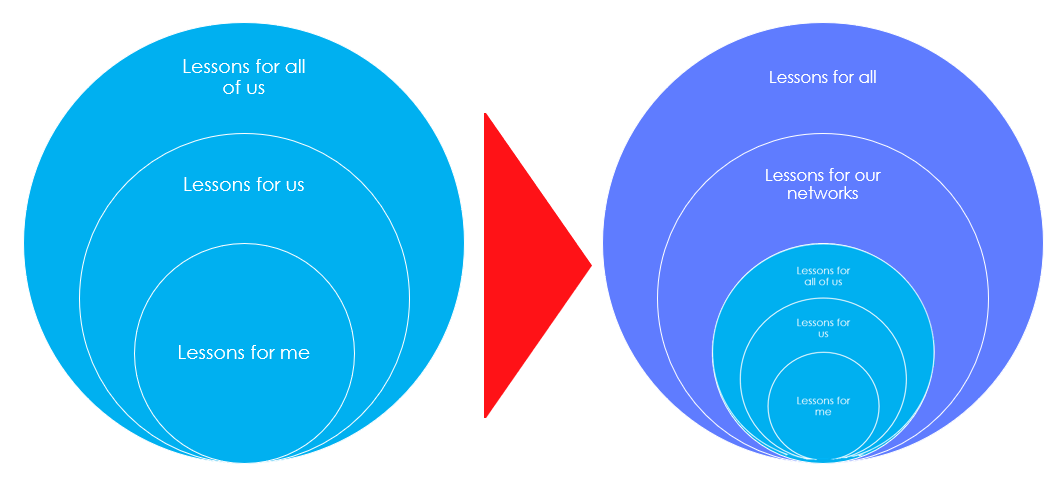
‘Lessons for me’ is clear – it’s me, personally, individually, whether internally in my mind and conscience or externally in what I now do as a result. It’s me, just me.
‘Lessons for us’ is a bit more negotiable. “Who are us?” Leif Edvinsson once asked a group of us. It’s negotiable who are us and who are ‘other’. Even in terms of a work team or project there are layers, and that bears some thinking about: Whose lessons are asked for? But I always meant this in the simple sense of those who take part in the lessons learned process. What do they learn?
‘Lessons for all of us’, however, at once simple and clear, is simultaneously more subtle and complex. Does it mean all the teams who do similar work (similar in some way) – all the project teams? Does it mean the whole organisation (which might, in any relevant sense, be the same thing). Or ought we to consider further reaches of ‘all of us’:
- our networks and communities: industry, standards and professional bodies, and wider stakeholder groups,
- and other, increasingly more inclusive sets, right out to “really everyone”?
All this means really is who is the lesson for, and what is the learning (in the sense of change or improvement) that is required?
Right now many different people and organisations are working to implement the UN Sustainable Development Goals, and, especially, to avert the worst outcomes of the climate crisis. This involves a great deal of innovation – both ‘brand new’ and ‘new to us’ (for many) kinds of innovation. It’s a race against time and against tide. The faster we can learn, and share our learnings to improve and accelerate both our knowledge and execution – in our different levels of lessons learned – the better.
 AI4KM - Robert Taylor