Ah! The times you get asked how many hits have your knowledge assets had! Or how many downloads, views or reads?
Of course it’s an interesting thing to know. If you’re producing digital knowledge assets and publishing them on some company or public platform, of course it’s interesting to know if they’re being looked for, found, navigated to, read and downloaded. In various ways and at different levels it’s an indicator of whether you’re targeting a real need, and effectively meeting it.
It would be nice also to know whether any of this publishing and “hitting” was actually contributing to any real good in the end – and that could be far more difficult to find out. And, of course, these figures may not really mean what people think they mean … which is a different discussion …
This question often comes from marketeers, oddly – – the people you might think would best understand targeting. But when it comes to online it’s too often seen as a competition for raw numbers.
Because, of course, what really matters is whether you’re getting the right hits.
My little picture below is one simple way to understand some of this.
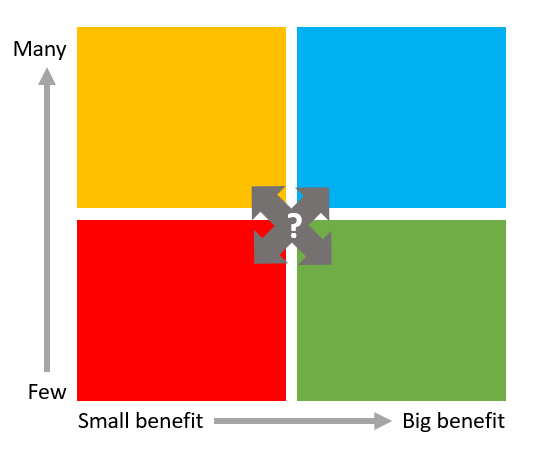
Down in the bottom-right, green area there may be very few customers (users, readers) or very few occasions relevant to a specific knowledge artefact. But if it’s the right artefact, the benefit when it’s needed could be very big.
I think of examples in my consulting career. In consulting you often get asked to turn your hand to a new problem, in a new domain (market/customer) and you need to figure out how to approach it from first principles, because it may not be just a case of repeating what you’re used to. Being able to find the right example – perhaps the plan for a similar* project done elsewhere, at another time, by another team, might give you the inspiration you need. I asterisked “*” similar because quite often the similarity may be tenuous, and the example may not be one you can simply copy (or you may draw on several examples that share different similarities with the new problem) but something that inspires and motivates you and enables you to make your own plan with a bit more insight.
Obviously the ‘hits’ in the bottom-right, green area are few. But I’m suggesting that this is at least the second best area to be playing in: The sum of all the small numbers of hits may be significant – and a good proportion of all of them may be getting at least appreciable or even major benefit. To appreciate this one should probably not be just totting up all the small numbers of hits on everything, but instead scoping it to just the most sophisticated knowledge artefacts: strategies, plans, analyses, models, sophisticated guides etc. – not things like templates and so on.
The templates and so on belong more in the top-left, yellow area. Frequently needed by many people, easy availability of company information, calendars, news and other such intranet-type information reduces friction (you’ll sure hear about it when these things are hard for users to access!) and helps things run smoothly. The knowledge content may be small – such as the correct statement to use to describe the business publicly – but it will have many impressions.
Obviously, we want to avoid costly and time-consuming attention to the lower-left, red area. It may be a no-go area for KM, or it may be an area for which you want the least-cost solution. What actually finds its way into this category may be surprising, since it sometimes includes things that have been specifically requested, and are then provided, but actually never used; and this is because we humans are sometimes quite bad at anticipating what we will actually do, protesting some version of our ‘best selves’ not borne out in reality. Users may ask for a step-by-step process guide, but, in fact, in real life most people’s instinct is the muddle through notionally rather than refer to a guide – which is why we need to design services to be user-friendly at the point they are used rather than having an adjunct guide you need in the other hand as you try to do something. The guide sounds to people like something they would use – – quite likely they wont. Not in all situations, of course! And maybe the training battle to get users to always use the more up-to-date guide is worth winning if the stakes are high enough.
Which way do you want to go? Of course, the top-right area, blue for excellence in this diagram, is conventionally reserved in the 2 x 2 matrix for the ideal, although I’d say the pragmatic choice is a balance and mix of the different areas. But just how do you reach top-right, blue excellence, where a knowledge artefacts has high value for many users/on many occasions?
In part it’s going to depend on how you measure or assess value. Some of my biggest successes with large numbers of high benefits from knowledge assets have come in the sales enablement area. I’ve mostly worked in businesses that make large numbers of highly customised bids for new business each year. Doing a complicated bid is a demanding job. Time is usually short. You need many different inputs and the people you need are unlikely to have much time spare to help you. You’re always dealing with novelty, under pressures of time, price and bid quality. And so on. Anything we can do in that area to make the many different knowledge assets that bidders might need to make their jobs easier or more successful have the potential for a big impact (win the bid!) and many uses.
But a whole KM household is not made by the sweet icing alone, and making a principled choice of how much to focus on the different knowledge artefacts, the different knowledge needs in each sector is all part of the job.
===
By my rough calculations that was KM Thought for the Day number 365 (and I’m not fussing if I’m one or two off either way). I didn’t start with the idea of one for each day of the year, but that idea developed around #200 I’d say. I started with the idea of using the simplicity of blogging, which doesn’t have the quality expectations of formal publication, to share a daily thought – not a fully-developed theory – about the work I do, and have done these 30+ years as a knowledge management lead and consultant. Nor am I stopping for want of new ideas: I usually have 200 or so ideas listed to be written (still do) but mostly, as today, write something different, that I happen to be thinking about, on the day instead.
I now plan to start a different series and a new blogging experiment.
 AI4KM - Robert Taylor