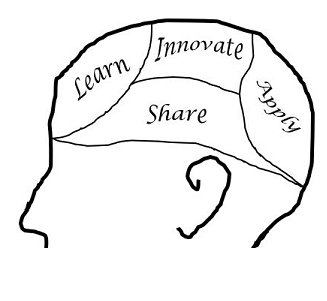
When I think about how I have mostly learned and improved my own KM competence and practice, my first thoughts are not the usual suspects of training, attending the big conferences, nor reading the big books.
Throughout my career, “knowledge” consulting, services and solutions has been a continuous and evolving thread. However, certainly in my earlier career and for many years I also spent half of my time and focus doing many other kinds of work: project management of an airport privatisation; developing and delivering management training; improvements to bank clearing; developing operating models and other projects in transport … and so on. Earlier on I eagerly took all opportunities to learn all the new skills, practices and markets that I could. Later, when I was more committed to KM, I confess to being more reluctant to spend time away from it. However, on reflection it was just as true later, as I had noticed earlier .. which is this: learning anything different, through the eyes of a KMer, I learned things that I brought back into my KM practice: business architecture, events and comms, project and change management, lots about IT, process improvement, operating models, policy change. So my first thought is that I’ve learned a lot for KM from doing other things that have added a range of skills, practices and perspectives to my KM.
Second, doing things or trying things and being very reflective and analytical is where I’ve learned most. Learning by doing beats any theory. One of the reasons I like tech is the ability it gives you to rapidly and very practically prototype and test an idea and get a far better sense of the size and shape of doing the thing for real will be than and purely intellectual analysis can ever give you. It’s easy to gloss over this very simple point – but my point is this: I hear lots of people recommend a course or a book but I recommend you spend your time giving it a go instead. If you think “it” is about communities of practice – then do some, don’t read about it (or don’t just read about it, at least). If you think it’s about influencing strategy by exposing what are the organisation’s differential knowledge strengths, then do that – don’t write an essay about it.
My third learning catalyst has been engagement with others doing this work. Actually doing some work with others who are engaged in KM has been a great way to learn together. Second best, but more available, I guess, is reading blogs – I like blogs over books since they’re less formal and closer to a conversation.
Finally, yes, you do need some grounding in the basic KM ideas and controversies and in the philosophy and science of knowledge and information, as well as organisational practice in general. But there isn’t one source you need to get this from, and, in my opinion, what these foundations are is still very fluid and is much more of a conversation than something didactic.
 AI4KM - Robert Taylor