I don’t think I’d get very far with a promise to increase inefficiency. People would think they misheard or I misspoke. Over the years I’ve promised and demonstrated KM interventions’ positive effect on improving efficiency many time – because information logistics is an area of general inefficiency in processes that KM can help improve through a variety of ways.
But today I’m praising inefficiency – or perhaps I’m lifting our sights to a second tier, whole system level of efficiency that risks being missed if we just optimise at ground level in the here and now; a second tier of efficiency that is realised, not at the level of the individual use case, but at a whole system level, over time, perhaps at the expense of specific efficiency targets. And it’s to do with a higher level of KM as well – learning and innovation, rather than information logistics (getting the right answer to the right person at the right time sort of thing).
Here’s an easy case to start with. Is it the most efficient use of resources to have them 100% utilised? Well, it might be and without any other context you might say well yes, of course, that’s the goal. But in many contexts it might not be the best answer overall and more generally as well it might not be too.
If those resources are people and you have them sprinting all day, every day you can imagine the effect on them. If those resources are hotel rooms then when do you ever get to redecorate? Maybe your reputation suddenly takes such a dive that you lose more than you ever gained, all for the want of a bit of slack. You can easily imagine many other such situations.
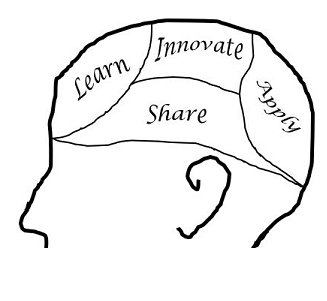
For example in the world of Agile (a fine philosophy for software development) there’s a heated debate about whether there should be a ‘HIP’ or ‘Innovation and Planning Iteration’ between development cycles [1]. The issue here, as elsewhere, includes an issue for KM which is that, if we optimise for today’s work today, then we risk missing the learnings and innovation that need slack-time-off from pure delivery in order to build capability and carry experience between one effort and the next.
Too busy and too successful today might not be the way of KM for sustainable progress.
[1] For example https://www.scaledagileframework.com/innovation-and-planning-iteration/ by Scaled Agile Inc 10 February 2021 (accessed 17 May 2022) – but you will find many other commentaries in the Agile world regarding ‘HIP’.
 AI4KM - Robert Taylor