We’re used to visualising the different degrees to which people engage with a community as a set of concentric circles, with the more engaged more central and the more occasional visitors further to the outside.
I’ve provided a version of this here, and it’s always a thought to consider what is the composition of any community in terms of where the action is, or, what we might regard as where the centre of gravity is:
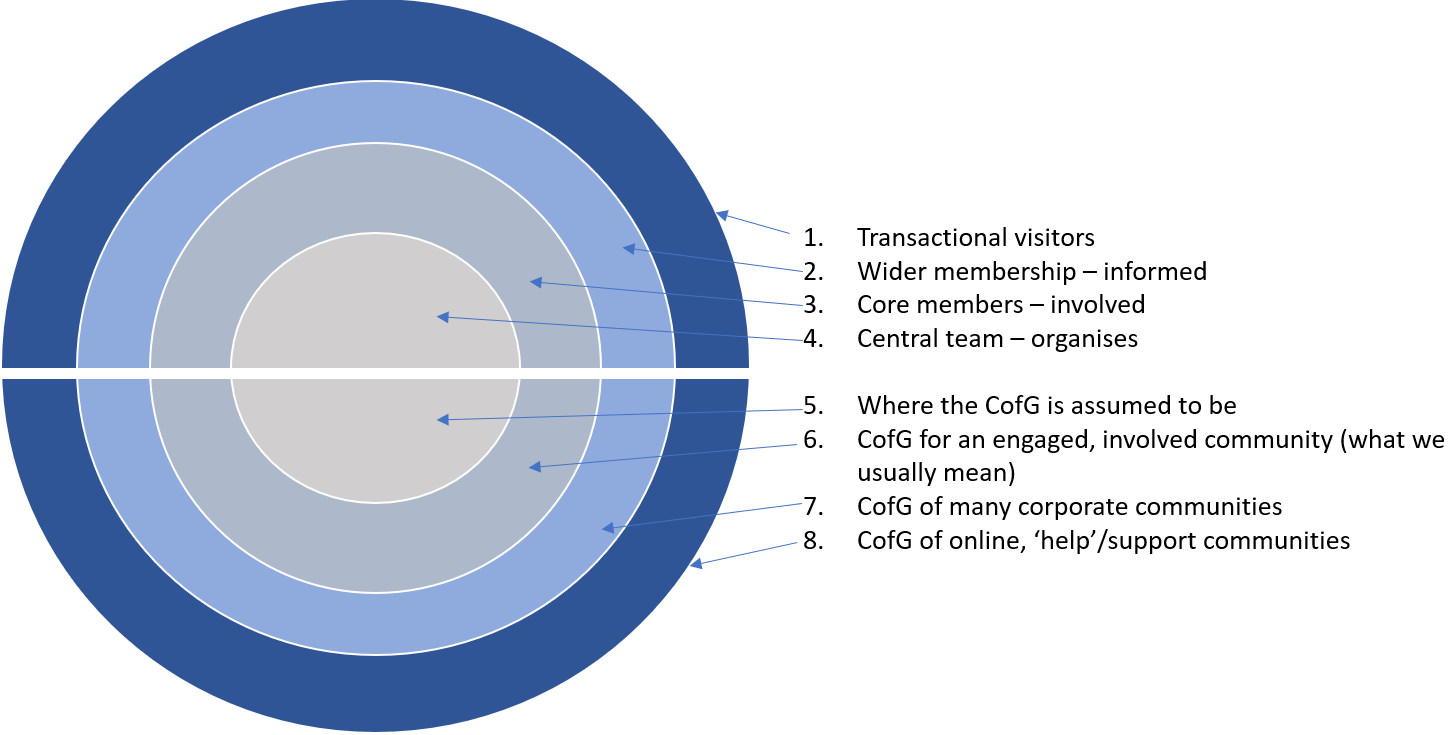
This perspective also helps me interpret some of the different uses of the term ‘community’. Many times the term is used to denote something far more transactional than I ever originally imagined. In that case the C of G of the community is towards the outer edge, for example in product support ‘communities’ [8]. In many companies what they call communities are really no more than passive groups of invitees to a monthly call and an intranet site [7].
The concentric circles diagram could lead one to believe that the pinnacle of success is to situate the C of G at the centre [5], but I think this isn’t quite right. I think that the logical centre of the diagram is where the community’s organising team sits, and it is instead in the very next adjacent orbit, [6], where one finds the most engaged participants and where you would might wish to see the the most activity.
 AI4KM - Robert Taylor