I’m very keen on Pfeffer and Sutton’s book “The knowing-doing gap” 1 which is all about how organisations confuse intellectual activities (knowing) such as planning and reporting with actual progress-making work (doing). But what if there was a doing-knowing gap as well? What would that be?
Surely the doing-knowing gap would be a failure to reflect on, learn from and share the experiences of doing the progress-making work.
Just as the knowing-doing gap is about getting stuck in the purely intellectual side, looking back over your shoulder after crossing the gap you would also see that gap back to the knowing world from your new perspective in the doing world.
If these two sides remain separated then they act our their parts in parallel worlds, one side dealing in the purely hypothetical, the other forging ahead with action, but likely incurring additional costs and creating excess waste due to a lack of the learning and improvement that comes from reflection.
In orthodox business practice, knowing world is very interested in plans and pledges – that are often not implemented nor re-visited, and in reports that reflect only the external controls (such as budget spent, % progress, estimate to complete) without capturing the meaning, significance and what has been qualitatively learned and gained from the experience. Maybe you know, from such data, how much of the tunnel has been bored, but you don’t know the real insights and innovation involved.
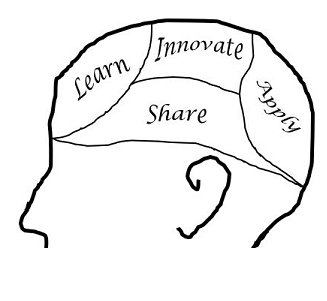
KM certainly has a role not only in bridging from knowing to doing (it matters not just to know but to apply knowledge and learn), but also back again from the field experience of doing to a new level of knowing, that powers better doing next time.
[1] Pfeffer, J. and Sutton, R.I., 2000. The knowing-doing gap: How smart companies turn knowledge into action. Harvard business press.
 AI4KM - Robert Taylor