One of the most famous ideas in Knowledge Management (KM) is tacit knowledge – a kind of ‘dark knowledge’, that must be there, somewhere, but that doesn’t show itself. We talk a lot about tacit knowledge in KM. But are we always talking about the same thing?
It’s not even all that clear that we’re all “as one” when we speak about tacit’s apparent opposite, explicit knowledge. So I’d like to offer you six degrees of knowledge along the tacit-to-explicit range, including five types of tacit…
The fundamental idea, of course, is that explicit knowledge is the knowledge that is “out there” – it’s recorded and written down – and also spoken, explained and discussed. Orthodox organisations love to deal with explicit knowledge because they think they can touch it in documents and methodologies and process diagrams and so on. It’s explicitness suits the prevalent materialist orthodoxy. Tacit knowledge, on the other hand is more mysterious – it’s not captured or written out in full. It’s ‘in heads’, or minds. And other places.
But as well as varying on this axis of unspoken to written down, knowledge also varies as to whether it’s known or unknown to the knower. Yes, that’s right – we don’t always know what we know or say ourselves.
So the six types of knowledge, including five that are referred to from time to time as ‘tacit’, are in that space between unspoken to written down, unknown to known:
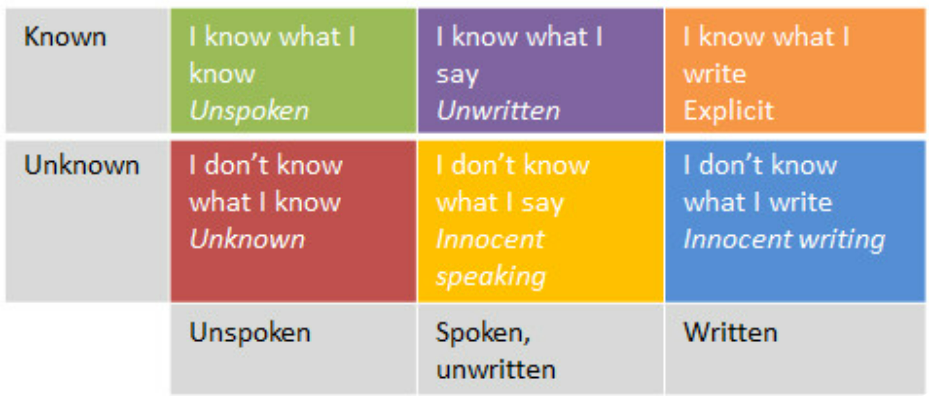
First we have the Unknown. This is the true tacit. It’s unspoken because the person with this knowledge doesn’t readily have access to it themselves – they’re not conscious of it. We often don’t really know exactly how we make decisions and our own mental models – including our biases, for instance – are often on our blind sides. We know that we can recover this knowledge, or parts of it, through detailed knowledge elicitation – but that’s time-consuming, costly and difficult work [also very enjoyable…]. This meaning of tacit isn’t very common, but I’d hold that this is the true tacit, and that probably most of all our knowledge is like this. It has a potential to be seen and articulated when triggered, but even this may well remain subconscious.
Speak in that Unknown knowledge domain and we then have Innocent Speaking. The speaker may not themselves be aware how their speech betrays their thinking, their biases, their strengths and weaknesses. The knowledge may still be tacit, but it is now being read by those with the ability to pick up on it. There’s probably almost always an element of the innocent in any conveyed meaning or force of an utterance.
Even if you write down knowledge there is still the potential for Innocent Writing, still a kind of tacit knowledge. I’d hold that there is always latent, tacit knowledge in speech and writing – unintended and unarticulated knowledge that can, nonetheless, still be received by the listener/reader. Isn’t this what a lot of that literature class stuff was all about?
Become aware of your Unknown knowledge (maybe through an ah-ha moment, realising what you’ve always misunderstood, perhaps), and yet fail to speak and we have Unspoken tacit. This is one of the most common uses of the term ‘tacit’ – i.e. the knower knows, but fails to (or has no reason to) articulate.
Speak what you are aware that you know, but without committing it to any permanent record such as a document and we have Unwritten tacit.
It is often presented as though the issue of tacit is that it remains unwritten – – often it seems to be suggested that, if only it were written down (“captured”) then all would be well with knowledge sharing. I wonder. I’m not of that view. I’m not really sure if Unwritten is tacit or explicit. I tend, in fact, to view it as explicit knowledge, but, in common usage within KM, Unwritten is referred to as tacit. So my fifth form of tacit is possibly only pseudo-tacit at best.
Which leaves the sixth form of knowledge, the undeniably Explicit knowledge. It’s written down for all to see and it was done so intentionally and consciously.
So in our transitions from tacit to explicit ….
Unknown –>(become aware) –> Unspoken [Unused]
–>(speak it [Use it]) –> Unwritten / Innocent speaking
–> (write it) –> Explicit / Innocent writing
 AI4KM - Robert Taylor