For as long as I’ve been ‘doing KM’ – at least 26 years – I’ve frequently seen reports and stats like this one (you might have seen it):
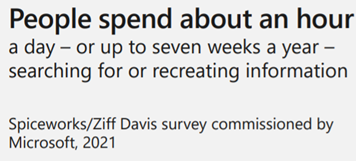
You can find it here. The fact that this has been virtually the same story for at least a quarter of a century provokes many thoughts. One is a memory of the soap powder that kept on coming out with new versions, each claiming to somehow finally be the one that washed your clothes clean: cleaner than ever, whiter than white – beyond which level was, apparently, that desirable ‘bluey whiteness’. So, we’ve had this problem of time wasted looking for information, or then giving up and re-creating the thing you couldn’t find, forever, it seems. And we’ve had solutions – the same ones, just a bit more bluey white each time, for as long a time as well. So, my thought is – is this just one of the eternal verities? – is it really wasted time (or, at least, is it all wasted time?) or is it just the time spent doing the perfectly legitimate task of ‘information research’? – and – how much of that allegedly wasted time can you actually recover?
In broad terms, I’m going with (i) it isn’t all wasted time, some of it is just the time that kind of work takes, but you can isolate some time that really ought not to be needed and for which you do have answers; (ii) you can probably – first guess, based on process improvement wisdom – get back half of that truly wasted time, but that is going to come at a cost as well so you’ll need to figure out the full life-time return in order to work out which interventions and improvements are worth it. But it’s answering those questions each time that matters rather than my rough-guide answers here.
Sometimes you’re going to need to do some calculations like the following (the 30% time lost was another figure I found easily enough when checking the reference above btw):
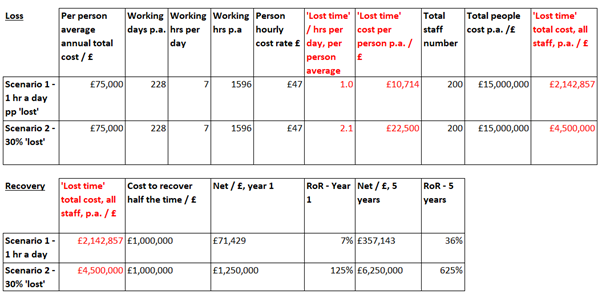
The actual numbers are not the point; the key point is that each number, and each column, and each calculation raises questions for you to answer about what is the definition of that thing, what do I include, how do I count it? – and so on.
It’s always easier when you define the scope more tightly by being specific rather than looking generically at the whole organisation. One real-life sales example was very much like scenario 2, above. Some of the numbers were different – the per person cost higher, the solution cost much, much lower, but the end benefit was North of £1m in time saved p.a. and the reason we could do that work was that the information being sought was very well defined (i.e. specific sales and product information and collateral), the amount of time wasted was easily established, and the solution was clear (complicated, but clear), because what was lacking was clear and well-bounded. I know many people stress about the business value of KM, but it’s really a much more feasible proposition when each separate problem is well defined – and much harder when it’s vague and general.
There’s another effect in this business of ‘time wasted over information’ which is that, most likely, with the tools and sources available now vs those 26 years ago, we’re probably reaching higher and reaching further when we do information research. I recall hearing it said that Sir Thomas Moore had read everything – everything that was available in writing in his era. There’s no hope of anyone ever again doing that, so of course research will take time.
 AI4KM - Robert Taylor